AS3990 Summary for Mechanical Engineers
Caliber’s Taylor Campbell gave an internal webinar on AS3990 – Mechanical Steelwork to help spread its relevance to our line of work. Chances are most mechanical engineers at Caliber will come across the need to use AS3990 at least once on their secondment, so we decided to give an overview of it and how it can apply to our line of work.
What Is It?
AS3990 is a traditional, but still compliant, method in evaluating stresses and applies to various specific mechanical equipment in addition to general steelwork. An example of general steel work might be the chassis of a vehicle, a structural component that if there are no other governing standards than a mechanical engineer could design to AS3990. It’s known as a Working Stress Method (WSM).
AS3990 is simplistic in its evaluation of stresses, it limits member stresses to its elastic region (conservative) by reducing the materials yield or ultimate stress by some factor depending on failure mode (bending, shear, bearing). The overall calculation is simple and straight forward that generally doesn’t require special software.
Key Sections
- Design of Beams
- Tension Members
- Design of Struts
- Connections
- Web Detailing
- Min/Max Bolt Pitch
- Bending in Pin
- Limitations
Design of Beams (5.0)
- Compression (5.3)
- Shear (5.10.1)
- Effective Shear Area Calculation (5.10.4)
- Bearing (5.11.1)
- Except at a holes
Tension Members (including beams) (7.1)
Design of Struts (6.0)
- Allowable buckling strength of strut based on l/r and (Table 6.1.1)
Connections (9.0)
- Max permissible stress in bolts, rivets or pins (Table 9.5.2)
- Tension (Table 9.5.2)
- Shear (Table 9.5.2)
- Bearing (Table 9.5.2, on plate)
- Min Edge Distance (Table 9.6.2):
- Welds (9.8) – To AS1554 and
- Shear (9.8.2)
- Recommended spacing for stich welding (9.8.4)
Web Detailing
- I-Beam Web Plate Min Thickness (5.13.1.1)
- Locating Web stiffeners (5.13.2.1)
Min/Max Bolt Pitch (9.6.3)
Bending in Pin (9.7.2)
It’s also important to know any standard’s limitations. AS3990 has several of them, but a few are outlined below:
Load Combinations (3.3.1)
- Simple 1:1 dead/live loading combination
- Recommendation: Use AS1170 when combining live and deal loads as it applies greater uncertainty to each.
Deflection (3.3.5 & Appendix A)
- Beams: Span/360 or Cantilever Length/180
- Recommendation: Use any adjacent standards to evaluate deflection as they would likely give more detail than Span/360 or /180
Fatigue (Appendix B)
- Prescriptive
- Recommendation: AS3990 outlines 29 different loading situations if your specific situation does not fall within one of these situations its difficult to use AS3990 fatigue standard. Look at S-N curves instead.
AS3990 Example
Hopper Transport Beams
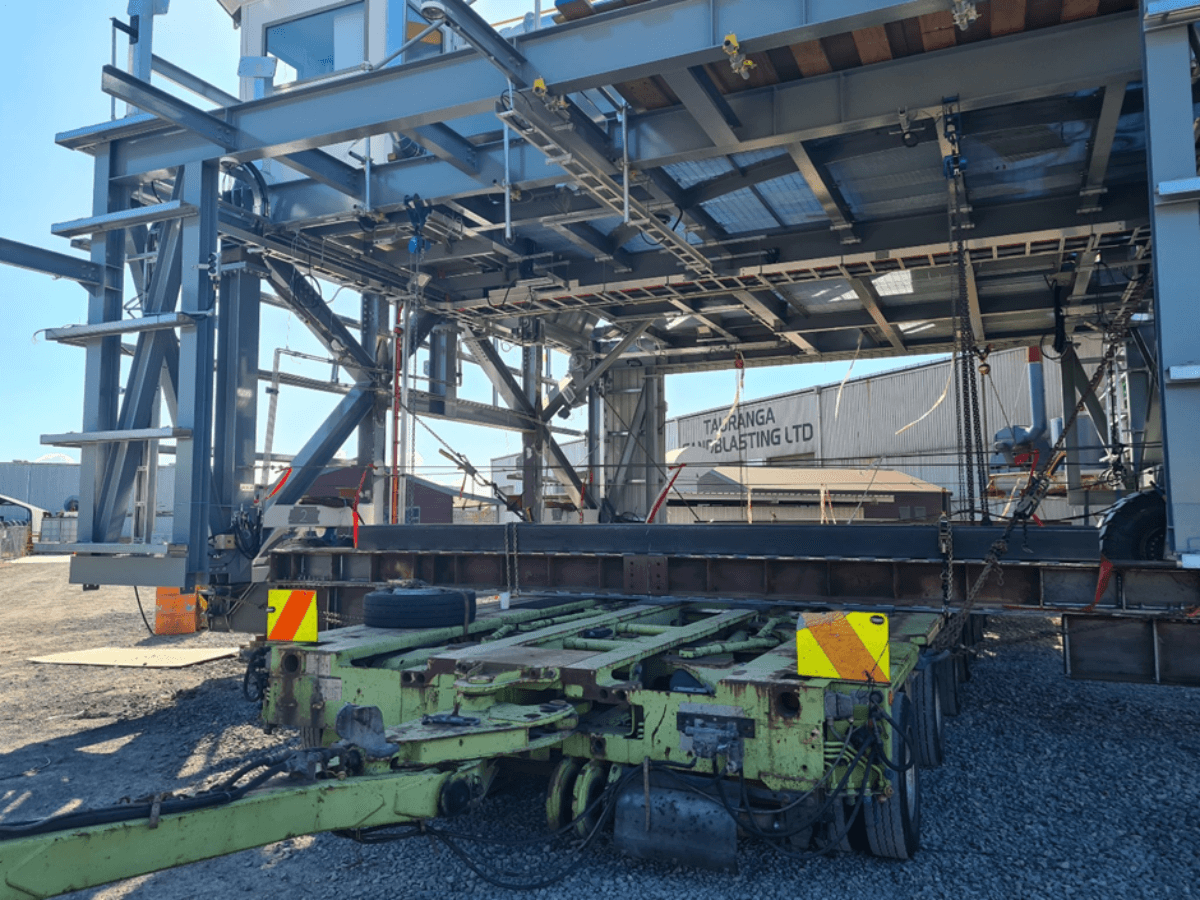
In 2021 Caliber was seconded to help design transport beams for a port hopper from fabrication site to the Port of Tauranga (approx. 2.5km). The client had an existing set of beams that were not quite fit for purpose so Caliber along with the client’s structural engineer designed the appropriate modifications to the beam (based on AS3990 on Calibers end) to accommodate the equipment being transported. Details of equipment being transported were:
- Mass: 85T
- Structure Column Centers: 9.7m x 9.7m
- CoG: 5.2m
- 6m W Trailer