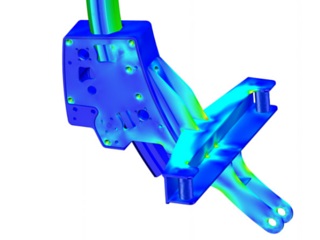
What do the FEA plots mean?
Understanding results means not only looking at the result plots, but also reading the analysis report (if you have one).
It is easy to create a result, but takes skill and understanding to create a result that is accurate.
Check that the constraints and forces make sense, read the assumptions, check the hand calculations, and then decide whether the conclusions are representative of reality.
Are the results correct?
It’s easy to create a stress plot and put it into a report. But is it right?
- Engineering calculations should never be neglected! Validate your FEA results to make sure they are correct!
- Applying constraints and forces differently can cause wildly varying results. You need to look past the final plot and think about whether the conditions applied to the model are accurately representing the real world scenario.
- A good analyst knows how and why they are setting up the FEA analysis. Experience and engineering judgement are the most important factors for creating the most accurate analysis.
- Physical testing is a great way to check your boundary conditions and results!
- If you have your analyst increase the deformation scale 100x, does the deformed shape look as expected?
Are the results correct ENOUGH?
Picture you are the manufacturer of mid range, low production run mountain bikes. You want to asses whether a small design change to an existing, successful product is going to increase or decrease the durability of the design. In this case, it may be appropriate to run a quick comparative analysis with some representative design loads.
If the new design is weaker than the current design, you may choose to avoid the design change or to tweak the design to improve its strength, regardless of whether the analysis is providing ‘exact’ results or not.
In a different scenario … you might manufacture bespoke high-value racing bikes for Olympic competition. In this case, a failure could both injure the athlete and significantly damage your brand, it may be prudent to analyse the bike in great detail . The challenge is to:
- Avoid ‘paralysis by analysis’
- Get the ‘level’ of analysis correct. What corresponding level of risk are you prepared to accept?