
CASE STUDY | Thor Poletest
Established in 2004, Groundline is a global consultancy providing transmission and distribution lines engineering services to network operators and service providers. Over this time their innovation hub both developed and commercialised a non-destructive testing system to determine the structural integrity of a timber utility poles. This technology replaces current pole ‘Sounding’ and ‘Sound Dig & Drill’ methods for pole health assessment, while providing integrated GIS positioning and in-depth analysis of pole assets. Now found at Thor Poletest, the system is proudly New Zealand made and has been adopted in 12 international markets.
THE CHALLENGE
The existing Thor Polestest system required a design iteration to update the function, features, reliability and improve manufacturability. Specifics included:
- Design for volume manufacture, local preferred
- Complete manufacture design drawings and information to de-risk single supplier parts
- Improved ergonomics and user feedback
- Improved serviceability
- IP54 environmental protection
- Improved aesthetic incorporating “Thor” branding
Groundline approached Caliber Design to assist with the following tasks:
- Generation of concepts
- Detailed design drawings
- Implementing and maintaining document release
- Prototype development and testing
- Liaison with contract manufacturers for initial production run
THE SOLUTION
The new design of the new Thor Poletest system was completed in full, within the targeted time frame, and on budget. This included a full CAD documentation set for components and assembly for the initial batch production run of 50 systems, scheduled for production at the end of 2021.
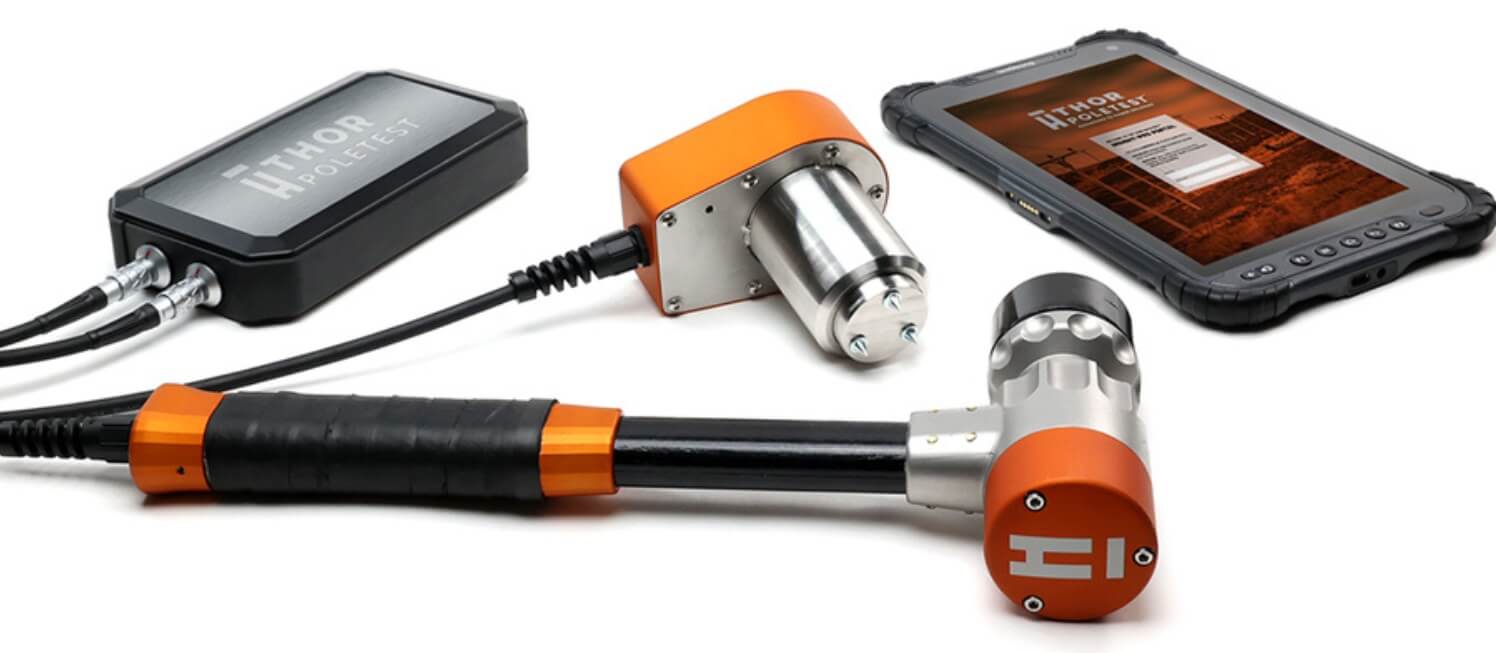
Our Caliber seconded engineer worked with the Groundline team to fully redesign all system components for local manufacture and assembly. This involved industrial design, product design, and design for manufacture of the following Thor Poletest system components:
Custom-designed force hammer:
- Utilise carry-over parts where possible
- Improved load path for load sensor accuracy
- Protection for the sensor wiring
- Fully sealed internals
- Fully serviceable components
- Stainless steel head construction with mass increase <20% while maintaining centre of gravity “feel” of the hammer
Custom-designed geophone sensor unit:
- Integration of load force cell and orientation sensor for user feedback
- Metal environmentally sealed housing for robustness
- Protection for the sensor wiring
- Fully serviceable components
Testing:
- Field testing of prototype system
- Highly accelerated life testing rig was designed to simulate a product lifetime of hammer strikes
- Environmental water submersion testing of all components.
One of the main challenges we faced was routing the sensor cable internally through the hammer shaft into the head while maintaining the strength of the head to shaft connection and environmental seal. We solved this problem by working with a local fibreglass pultrusion manufacturer. A hollow fibreglass hammer shaft was formed, which was glued and pinned into the hammer head. Mechanical fatigue testing was undertaken using a bespoke hammer impact rig to ensure hammer was fit for purpose.


For a complex new product development we needed support with detailed mechanical component design, product integration, and production-ready documentation. Based on a position brief, Caliber provided the right person fitting in well with the team. Over the last year we saw a product specification moving into a detailed production-ready design, the establishment of a supply chain for components, and the testing of prototypes resulting in a manufacturing start in time on spec on budget.
Along the journey all required documentation (i.e. BOM, Specifications, Manuals,...) was done in a concise way and shared with the team as expected. We appreciated the "no surprise" communication sorting out issues and roadblocks as they arise. The seconded engineer integrated into our systems with ease, applied our processes as required and in cooperation with the team added new steps when bottlenecks or shortfalls were detected.